Why Exposure Alone Doesn’t “Fix” Reactivity (and What Your Dog Actually Needs)
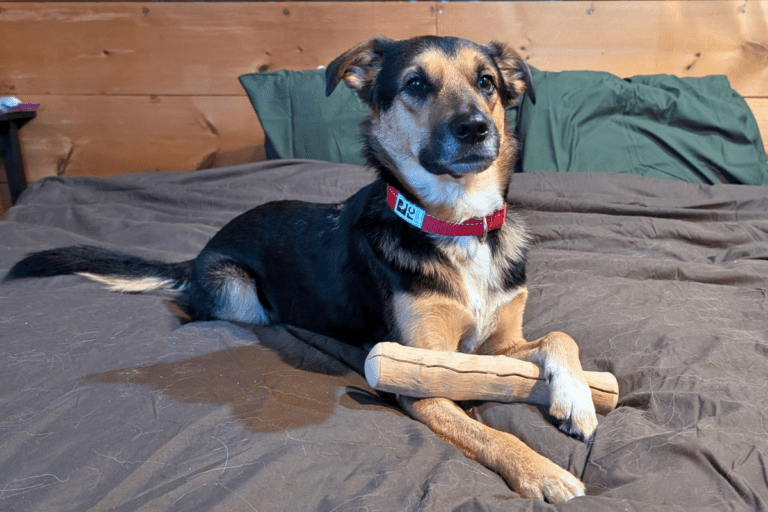
In the early days of navigating life with Lucifer, I found myself constantly pressured by well-meaning people around us to “just get him out there.”
I was led to believe that if he could only see enough of the world, he would eventually realize it wasn’t a threat.
This is the all-too common myth of exposure: the idea that proximity equals progress.
We are told that if we expose our dogs to their triggers frequently enough, they will eventually get used to them and it will magically “fix” their reactive behaviour.
In reality, exposure without a plan is often just a recipe for added stress.
For a dog like Lucifer, whose nervous system is always running on high arousal, simply existing in the presence of a trigger doesn’t create neutrality; it reinforces his fear.
To truly support a reactive dog and improve their quality of life, we must look beyond the surface behaviour to understand what is driving it and address it directly.

Exposure vs. Desensitization
To understand why simple exposure often fails, we must first distinguish between being present and actually learning new responses to a trigger.
In the world of dog behaviour, these two concepts are frequently confused, but the results are polar opposites!
Exposure introduces a significant risk: flooding.
Flooding occurs when a dog is exposed to a trigger at a level too intense for them to cope with, effectively “drowning” them in fear.
When a dog is flooding, they may eventually stop reacting, but this is rarely because their fear has gone away. Instead, they have often reached a state of learned helplessness, causing them to shut down.
This can even make your dog MORE sensitive to the trigger.
Understanding the Threshold Concept
One of the best ways I’ve been taught to visualize Lucifer’s emotional state is to think of it as a traffic light.
This allows me to determine what efforts are safe (when he’s able to learn) and which are likely to cause him to shut down or make the situation worse.
- The Green Zone (Below Threshold): The dog is aware of the environment but relaxed. They can take treats, offer eye contact, and sniff the ground. This is where learning happens.
- The Yellow Zone (Approaching Threshold): The dog is alert and focused on a trigger. They may stop taking treats or become stiff. This is the point when we, as responsible dog parents, must intervene.
- The Red Zone (Over Threshold): The dog is lunging, barking, or frantically trying to escape. In this state, your dog is no longer able to think or respond carefully; they are overwhelmed and acting on instinct.
Often, when people say that a dog just needs to be exposed to a trigger, they are actually forcing their dog to exist in the Red Zone.
At this point, they aren’t able to process new, positive information. Instead, they are in a high state of arousal and possibly even reinforcing or strengthening their fear.
If you want to make progress with your dog’s reactivity, you have to start with a foundation of trust and safety.
If your dog feels they cannot escape their trigger or that their boundaries are being ignored, they will move into survival mode (reacting). They can’t trust you to protect them; they have to take steps to protect themselves.
Each time your dog is “exposed,” they are practicing the very behaviour we are trying to minimize, effectively reinforcing that it is how they need to react next time.
What is Trigger Stacking?
Reactivity rarely happens in a vacuum. It is often the result of trigger stacking. This is a phenomenon in which multiple small stressors build up until the dog can no longer cope.
Think of your dog’s ability to handle stress like a bucket.
A loud truck in the morning adds a cup of water…
A delivery person at the door adds another…
By the time you run into a dog on your walk, the bucket is already overflowing.
Trigger stacking effectively shrinks the Green Zone. A dog that might normally tolerate a bicycle passing twenty feet away may lunge at that same bicycle when it reaches fifty feet if they have had a stressful morning.
As dog parents, we often miss the micro-stressors that start building up, leading to the mistaken belief that a reaction came out of nowhere.
The Cortisol and Adrenaline Hangover
When a dog enters the Red Zone, their body is flooded with adrenaline and cortisol, preparing them for the “fight or flight” response.
These stress hormones don’t disappear the moment the trigger is out of sight.
While adrenaline spikes and fades relatively quickly, cortisol can stay elevated in a dog’s system for 72 hours or even longer.
If you are planning any training the day after a reactive event, you are working with a dog whose baseline stress level is already high.
This makes a second reaction far more likely and significantly more intense.
This is why decompression days (days with zero triggers) are so important. They allow the nervous system to return to a baseline state.
Reactive vs Responsive
All of this information is key to understanding how to move your dog from a reactive state to a responsive one.
A responsive state is one where your dog can acknowledge a trigger, check in with you, and make a conscious choice to engage in a healthy, positive way.
Achieving this shift requires recognizing and respecting the Yellow Zone.
We need to prioritize our dog’s emotional state over our desire to make progress.
By focusing on keeping the bucket empty and respecting their need for recovery time, you create an environment where true learning can finally happen.
The Difference Between Presence and Neutrality
A common mistake made in exposure-based training is the belief that if a dog is looking at a trigger and not lunging, they are getting used to it.
However, simply being in the presence of a trigger doesn’t automatically mean a change in their emotional state.
If your dog is staring intensely, frozen, or refusing food, they aren’t becoming neutral.
- Tolerating a Trigger: If a dog is still, but their body is stiff, their breathing is shallow, and they are hyper-focused on the trigger, they are essentially holding their emotions in. Eventually, like a pressure cooker, the situation will blow up.
- Processing (Active Learning): If your dog sees a trigger, acknowledges it, and then disengages, they are learning to coexist. They may start sniffing the grass, looking to you, or shaking it off. This is a sign of a healthy nervous system.
The Three Pillars of Progress
Once we accept that exposure alone doesn’t fix reactivity, we can shift our focus to strategies that can actually reshape how our dogs respond to triggers.
This transition requires moving away from the “face your fears” mentality toward a plan that includes safety, positive associations, and a sense of control.
We aren’t just waiting for them to stop reacting; we are giving them a new set of skills and a confident sense of safety, making the unwanted reaction unnecessary.
1. Management as a Tool, Not a Failure
In the reactive dog community, there is often a sense of guilt associated with avoidance.
However, management does not necessarily mean you are failing. It is a necessary step to prevent your dog’s bucket from overwhelming.
The goal of management is to ensure that your dog never feels the need to resort to reactive behaviours to feel safe.
When they learn that they can trust you to keep them safe, they will lower their guard.
This may involve strategic changes to their environment, such as:
- Using window film to block visual triggers at home
- Choosing quiet walking routes
- Relying on visual barriers like parked cars to break the line of sight during a walk
- Sticking to enrichment at home for a day instead of walking the neighbourhood
Always prioritize your dog’s recovery window.
If Lucifer has a reactive event on a Monday, management becomes our primary focus through Wednesday.
By avoiding and controlling exposure to triggers entirely during this recovery period, we prevent the “hangover” from becoming a permanent state of hyper-vigilance.
2. Counter-Conditioning and Systematic Desensitization
This is the gold standard for changing how your dog feels about and responds to a trigger.
Rather than just being near a trigger, we are actively pairing its presence with something of high value.
When your dog looks at the trigger from a safe distance but doesn’t react, reward them.
The reward must happen while the dog is still in the Green Zone or Yellow Zone. If they are already barking, the window for counter-conditioning has closed.
We only start to shorten the distance when Lucifer starts to anticipate the reward happily at the sight of the trigger (sees it and instantly turns to us for a reward).
If he is still stiff or unsure, we stay at the current distance or even move further away.
3. Building Confidence Through Choice
One of the biggest realizations I have had during Lucifer’s journey was how much of his reactivity was fueled by a lack of control.
When he felt he had no control over the situation or his safety, he would resort to survival instincts.
By giving him a say in his environment, I can build his confidence and help him learn to stay calm even when a trigger is present.
If I can see that he is looking away or disengaging from us at any time during a training session, I respect that “no” and either end the session or move him further away from any potential triggers until he shows he’s ready to work again.
Another great way to teach him that he has control is to use a “let’s go” cue.
When we encounter a trigger, and the command is given, a U-turn before a reaction occurs shows him there is an escape route he can take, rather than needing to react to protect himself.
These actions help empower him to feel calmer and more comfortable in his environment.
Success is a Feeling, Not a Behaviour
When I look back on my early days with Lucifer, I realize I was measuring our success by how close we could get to a trigger without an explosion.
I was focused on the external. On the silence, the slack in the leash, the physical proximity.
But as I moved away from the myth of exposure and toward a deeper understanding of his emotional health, my focus changed.
True progress isn’t found in his ability to tolerate a crowded park; it’s found in giving my boy a life that feels safe enough to exhale and just exist.
You are not failing your dog by keeping their world small, especially in the beginning. You are giving them the greatest gift a reactive dog can receive: the peace of mind that comes with finally feeling safe.